
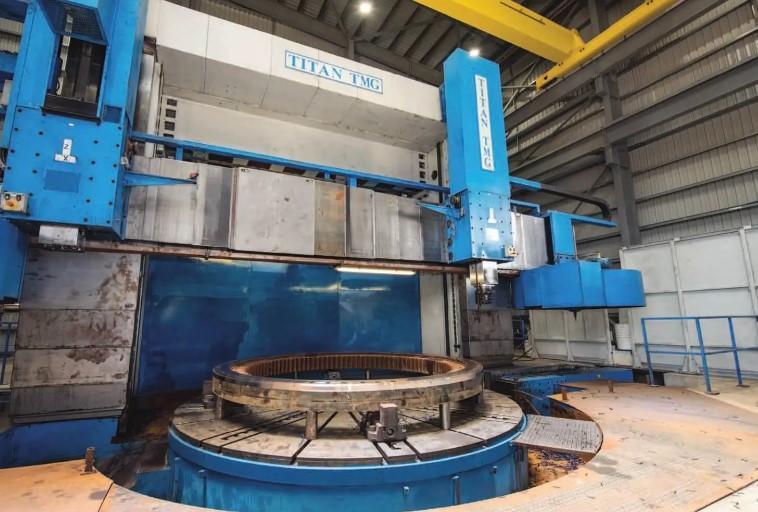
For most Queensland operators, large components requiring precision boring above 3–4 metres in diameter have meant one outcome: the work leaves the state. Interstate freight, extended lead times, limited visibility over quality during machining, and maintenance windows that blow out before the component even returns to site are familiar costs for any engineer who has managed this class of component.
This article covers vertical boring mills from the ground up: how they work, what they machine, which specifications actually matter, and why local capability at this scale changes the equation for mining, power, and defence operators. If you make large-format machining decisions and you're tired of the logistics, start here.
Table of Contents
ToggleWhat Is a Vertical Boring Mill and How Does It Work?
A vertical boring mill is a machine tool designed to rotate a large workpiece on a horizontal table while fixed or live tooling performs boring, turning, and milling operations from above. The key difference from a horizontal lathe is orientation: standing the workpiece upright means gravity works in favour of the setup rather than against it, and that matters considerably when the component weighs 15, 30, or 50 tonnes. The workpiece sits on a rotating faceplate or chuck, and tool heads mounted on cross beams move in multiple axes to perform internal boring, external turning, and face milling in sequence or simultaneously. Live tooling refers to powered tool heads that can mill, drill, or tap features while the workpiece remains on the machine, so there is no need for a separate setup elsewhere.
Modern VBMs use CNC control systems, such as the Siemens 840D, to hold tight tolerances across large diameters that manual setups cannot reliably achieve at this scale. The double column configuration adds structural advantage because two vertical columns support the cross beam from both sides, providing the rigidity needed for heavy cuts on large components. Deflection, the slight flexing of a machine structure under cutting load, is a genuine problem on single-column machines at this scale, since it can push a bore measurement outside tolerance without the operator detecting it until final inspection. For a 4-metre turbine casing or a large crusher bowl, that rigidity separates a component that meets drawing tolerances from one that does not.
What Components Are Machined on a Vertical Boring Mill?
Vertical boring mills exist because certain components cannot be reasonably set up any other way. In mining, that means mill liner housings, crusher bowls, rotary kiln tyres, large bearing housings, and sheave wheels. In power generation, the list includes turbine casings, runner crowns, large flanges, and generator end shields. Defence and oil and gas applications add pressure vessel ends, propulsion housings, compressor casings, and large valve bodies. The common thread across all of these is size, weight, and precise bore tolerances that cannot be compromised.
Most of these components share a further requirement: multiple operations must be completed in a single setup to maintain concentricity. Concentricity means that bored features share a common centreline, which is critical for components like turbine casings or pump housings where a rotating shaft must run true through multiple bored surfaces. Repositioning a 30-tonne component between machines introduces measurement and alignment error that compounds through each subsequent operation, so a VBM with live tooling eliminates that risk by completing internal boring, external turning, and milling in one continuous operation without the component leaving the chuck. For work where bore-to-face squareness or concentricity is a functional requirement, single-setup capability is not a convenience.
What Specifications Matter When Sourcing VBM Work?
Seven specifications determine whether a VBM facility can handle your component. Swing diameter sets the hard limit: if your component exceeds the machine's maximum swing, the conversation ends there. Workpiece weight capacity covers the chuck and table load rating, which is critical for cast or fabricated components above 20 tonnes. Workpiece height defines maximum vertical clearance, relevant for tall components like turbine casings and large cylinders. Spindle RPM range determines whether the machine can handle both heavy roughing cuts and fine finishing passes in the same setup, because a machine limited to slow finishing speeds will struggle with initial stock removal on a large casting. Live tooling capability allows milling and drilling without repositioning the component. CNC control system governs programming flexibility, tolerance repeatability, and compatibility with complex geometries. Simultaneous channel capability means running boring, turning, and milling operations concurrently, which reduces cycle time and becomes critical when a shutdown window is fixed.
Specifications alone, however, do not complete the picture. A machine with the right numbers operated without certified quality systems, experienced operators, and full documentation capability is still a risk for any component carrying compliance or safety obligations. So before committing a critical component to any facility, verify the quality certifications, ask to see records from comparable jobs, and confirm that the documentation provided with the finished component will satisfy your audit requirements.
Why Local VBM Capability Changes the Equation for Queensland Operators
Sending a large component interstate for VBM work carries costs that rarely appear in the line-item quote. Freight for components above 20 tonnes is substantial, but the schedule impact is the larger problem. A round-trip logistics cycle adds 3 to 6 weeks to a project timeline before machining time is even counted. Reduced visibility over work in progress makes it harder to catch issues early or respond to scope changes, and transport insurance for a component that is irreplaceable or carries a long lead time adds financial exposure that the machining quote does not reflect.
Local capability changes each of those variables. Machining lead times can align directly with planned maintenance windows rather than forcing engineers to schedule work weeks earlier than the operational situation warrants. Work can be inspected in person during machining, and scope adjustments can be addressed in a phone call rather than a freight cycle. Berg Engineering's Titan SC 40/50-4HY Double Column Vertical Boring and Turning Mill, located in Gladstone, QLD, handles components up to 5 metres in diameter, 50 tonnes in weight, and 2,950mm in height, with simultaneous three-channel machining capability. Originally manufactured in Europe for nuclear and defence applications, the Titan was built to the precision and documentation standards those sectors demand, and the same machine now operates in Gladstone, so your component does not have to leave Queensland to access that standard of work.
Conclusion: Matching the Machine to the Job
Getting large-diameter VBM work done above 3–4 metres has always required more than finding a machine with a big enough swing. The tolerance requirements, documentation standards, and operator experience needed for components going into mining infrastructure, power generation, or defence applications are demanding, and most general machining shops that have the physical capacity do not have the certified systems to match it. For Queensland operators, that gap has historically meant one outcome: the component leaves the state.
That has changed. The right VBM facility brings together machine specifications, certified quality systems, and demonstrated experience with comparable components, because all three matter equally. A machine without the systems behind it is still a risk. For Queensland operators with large-diameter machining requirements, Berg Engineering now offers purpose-built vertical boring capability at a scale previously unavailable in Central Queensland, backed by the quality certifications and technical depth the work requires.